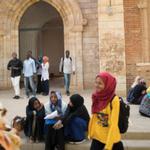
The table has turned: Sudanese businesswomen challenging gender roles
Having fled from war, Sudanese are forced to build a life for themselves in exile. Women are at the forefront of this reinvention, taking up new trades. In the process, they are turning gender roles upside down.
Having been forced to flee from war and violence, leaving everything behind, many Sudanese have had to build a new life for themselves in cities in neighbouring countries. In displacement, many end up living nearby their country men and women, giving whole neighbourhhoods a feel of home. Sudanese bread is being sold in corner shops. The smell of the incense bakhoor seeps through the doors of restaurants. Homemade jewelry, cheese, soaps, and perfumes swiftly change hands.
These emerging Sudanese communities are very industrious and in many instances women led. And they are challenging the traditional views on a woman’s place in the household.
Building a supportive environment
The Sudanese who have been displaced have all been hit hard by the war, but with very different socio-economic backgrounds, they have had unequal starting points when it comes to building a new life. Randa Hamza Ibrahim Gindeel, Sudan-Norway Academic Cooperation (SNAC) affiliate and associate professor at Ahfad University for Women, reminds us that the word ‘everything’ can harbour a hundred different meanings.
-‘We lost everything’ could mean anything, from literally everything in the sense of the most basic amenities to big villas and expensive cars, she says.
While some are struggling to put food on the table, others have established themselves in their now homes, buying apartments, contributing to the local community, and successfully running their new businesses. Many of the women who now run their own businesses belong to the middle class and have access to both resources and networks. But despite their different backgrounds, they are all united by the experience of displacement.
-What first and foremost characterizes these communities is a strong sense of solidarity and support. At makeshift bazaars and permanent shops, women come together not only to buy each other’s products, but to talk and share experiences, says Gindeel.
The new breadwinners
In many displaced families, women are now the breadwinners. It is a change that has been hard to accept for many men.
-But seeing that the money comes in and finances the children’s school fees and puts food on the table, they change their mind, says Randa Hamza Ibrahim Gindeel.
Gindeel argues that the current situation calls for a redefinition of the concept ‘breadwinner’.
-In Sudanese culture, the breadwinner is unequivocally connected to the husband. In displacement, we see that women are now taking a leading role, challenging traditional mindsets. Or the breadwinner could be a brother, an uncle, or a relative who works in one of the Gulf countries, she says.
With relatively higher expectations to what constitutes a sufficient income and usually looking to start businesses that require a start capital, securing jobs and business opportunities have turned out to be harder for many Sudanese men than for their female counterparts.
-For many, it has been so hard that they have given up on building a career and have travelled back to Sudan, leaving their wives and children in their new homes in exile. Others have chosen to stay but now depend on their wives or relatives to make ends meet, says Gindeel.
The women, on the other hand, have tended to do business on a small scale. And for some, what was simply a way of making ends meet by adding a little extra to the household, has now become not only a steady source of income but also an identity marker.
Filling in knowledge gaps
Randa Hamza Ibrahim Gindeel speaks from experience. She embodies the spirit of the industrious Sudanese women who are now flipping the gender roles. She has taught business strategy herself and is particularly well placed for understanding the circumstances displaced Sudanese women find themselves sin.
In her current research, she does fieldwork among fellow businesswomen, exploring their business community through an anthropological lens, and publishing on the topic in cooperation with social anthropologist Ann Cathrin Corrales-Øverlid from the University of Bergen as part of the CMI/University of Khartoum led Sudan-Norway Academic Cooperation (SNAC).
They come from very different backgrounds: Randa is an associate professor of sustainable rural development and deputy vice president for academic affairs at the Ahfad University for Women. But she has also worked in fields like gender studies, and education in displacement contexts, and this is where her research interests converge with Corrales-Øverlid who for example has studied Latin-Americans’ experiences in the US and Norway. Throughout their cooperation, Gindeel and Corrales-Øverlid have reflected on what it is like to collaborate across disciplines and have concluded that it feels a bit like bridging a divide where one has been shaped by the academic setting, perspectives, and contrasting resources of the global North and the global South. Yet those differences have turned out to be a strength.
-These differences make it clear that we complement each other, she says.
In fact, Gindeel and Corrales-Øverlid have discovered striking similarities in how they think and work, above all their shared interest in how displaced people cope and create new homes. While their research converges on this theme, Randa brings something unique to the table: her own experience of displacement.
-This perspective is missing from current theory and is where our joint work can help fill critical knowledge gaps, she says.
Project