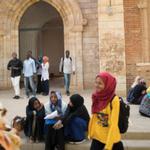
Crafted life: The architecture of women and everyday life in Eastern Sudan
In Eastern Sudan, women’s work forms an economic system of its own. Largely absent from official statistics, this system is what sustains households and local communities. Spanning agriculture, fisheries, crafts, and domestic labor, it provides the foundation for everyday life and compensates for the absence of the state.
Eastern Sudan is often described in terms of its deficiencies: weak infrastructure, limited services, chronic poverty, and environmental fragility. But this description obscures a deeper reality: The region is held together more by social systems than by governmental ones. Communities are sustained by kinship institutions, neighborhood alliances, and women’s labour.
In the context of the Beja communities of Eastern Sudan, an indigenous Cushitic-speaking people who inhabit the Red Sea hills, coastal plains, and desert corridors of Eastern Sudan, women’s labour functions as a coherent economy. At the heart of this system are women, whose daily work functions as an alternative infrastructure that sustains communities where the state is absent.
These women may not appear in national accounts or economic statistics. Yet it is their work that keeps Eastern Sudan alive.
An alternative economy founded on women’s labour
Understanding the work system in Eastern Sudan requires examining the social structure that organises and shapes women’s daily work in the agricultural, maritime, artisanal, and domestic sectors. Limited access to education constrains women’s opportunities. Many have little or no formal schooling due to poverty, domestic responsibilities, patriarchal norms, and a lack of functioning schools. More than half of women in the region have not completed formal education, often due to poverty, household labour demands, and a shortage of teachers and functioning schools (OCHA Sudan: Red Sea State Profile (March 2023) | OCHA). These conditions shape every decision women make about work, movement, and survival.
Yet, despite these constraints, women sustain a wide range of activities. From farming and fish processing to handicrafts and cooperatives, their work provides income, food security, and social support where formal systems fail to deliver. As a result, women’s economies now operate as the region’s most dependable development infrastructure, sustaining both households and the wider local economy.
Culture as a social space: How women navigate social boundaries
Women’s work in Eastern Sudan, particularly among Beja communities, is shaped by cultural dynamics that operate through everyday expectations rather than formal rules. Kinship structures influence where a woman can work, who accompanies her, and how far she can travel, while honor norms regulate the visibility of her labour in public spaces. Language further shapes access, as many Beja‑speaking women avoid Arabic‑dominated offices, training centers, and administrative procedures that feel exclusionary. At the same time, collective memory transmits skills such as weaving, pottery, hairdressing, and preparing traditional foods, forming the foundation of women’s micro‑economies. Through daily practice, women navigate these norms and reinterpret them, crafting livelihoods that fit social expectations while gradually expanding their agency. This subtle, continuous negotiation constitutes a quiet form of governance that shapes the organisation, value, and social recognition of women’s work.
Women’s livelihoods: A multi-layered and adaptable economy
Across Eastern Sudan, women move across multiple layers of social organisation: managing household resources, coordinating tasks, and sustaining the rhythms of daily life. Their work is distributed across three primary domains.
Handicrafts and home-based production are among the most visible and socially accepted forms of women’s labour. These activities include palm-leaf weaving, pottery, hair braiding, and the preparation of traditional foods. In this culturally governed context, women are not only limited in where they can market their products but also in the kinds of economic activities that are considered socially acceptable. As a result, income-generating activities often build on roles already associated with women’s domestic responsibilities. One example is the sale of porridge (Utum) in Port Sudan. As a culturally valued staple associated with women’s domestic role in food preparation, its sale provides a socially accepted path into the marketplace and a source of income.
Handicrafts and home-based production are among the most visible and socially accepted forms of women’s labour.
These skills are passed down across generations and form part of both cultural identity and economic survival. As an artisan trainer (H) explains: 'These crafts are inherited knowledge, and if categorized adequately, they can become a stable source of income for women. In Eastern Sudan crafts and handmade goods are deeply rooted in culture and they represent market potential.'
In agricultural areas such as Tokar, women sustain households through activities such as grinding grain, managing seeds, selling water, and organising food-sharing networks. Despite recurring floods and drought, they adapt by diversifying income sources and strengthening cooperation between households.
Along the Red Sea coast, women are also deeply involved in fisheries. Although traditionally dominated by men, women have long participated in fish processing and trade, and their role continues to expand. The Friends of Fishermen Association in Red Sea State, a community-based organisation, has become a pivotal institutional player in supporting this ongoing transformation. In cooperation with UNIDO since 2024, the association has strengthened and formalized women’s engagement in the sector by providing training in fish processing, hygiene, and value addition, as well as access to drying racks, storage spaces, essential equipment, and local and regional markets.
As a member of the Fishermen’s Friends Association explains (R): ‘Women’s presence in the drying and preparation stages are extremely important. We, as women, depend on the work of the fishermen, and we train women to maintain product quality and prepare it for the market. For three years the Association faced barriers to its work, as this field was publicly dominated by men although a significant role was played by women.’
They have also trained women in netmaking in collaboration with FAO, strengthening women’s role as embedded within the productive structure itself. This recognition helps shift perceptions of women from 'helpers' to essential actors in the value chain.
The Faculty of Tourism and Hotels at Red Sea University also plays a crucial role in expanding opportunities for women, strengthening the systems they already sustain and contributing to a more resilient local economy. The faculty provides an important institutional bridge capable of documenting women’s knowledge, training youth, and linking living heritage to market opportunities.
Support from the collective
Local solidarity networks in the shape of cooperatives play a crucial role for the women who work. Every week, they gather for a coffee ceremony to exchange updates, divide tasks, and discuss challenges. In this space, work and social life blend seamlessly. In practice, these cooperatives fill the void left by weak state structures by redistributing risk and strengthening resilience.
Local solidarity networks in the shape of cooperatives play a crucial role for the women who work.
As a member of the Red Sea Women’s Umbrella, an organisation which includes fifty women’s bodies including cooperative networks, explains (H): 'We don’t work alone. Each cooperative supports the other. Sometimes we share the profits, and sometimes we share the losses. What matters is that work continues’
Development challenges: The daily obstacles women face
The current situation in Sudan marked by institutional collapse, large-scale displacement, and the erosion of basic services has intensified the pressures on women’s economic systems in Eastern Sudan. As state structures weaken and access to services and markets becomes more unstable, women’s work has become central to community survival.
Amid displacement and deteriorating public services, women sustain livelihoods through kinship networks, neighbourhood alliances, and cooperatives while navigating cultural expectations around acceptable work. They choose workspaces that allow them to earn income while controlling their public exposure, like processing fish in courtyards or weaving palm products at home. What counts as “acceptable” work shifts over time: Net-making in Mohamed Qol, for instance, became legitimate after NGO training framed it as a technical skill. Work in the fish industry became recognized once women entered the value chain. Through these practices, women organise resources, sustain households, and form a quiet but essential system of local economic governance.
This Sudanese Perspectives blog post is written by Khadiga Mustafa, graduate of Sociology and Anthropology at the University of Khartoum , and a postgraduate in Gender and Migration Studies from Ahfad University for women.
The views expressed in this post are those of the authors, and do not necessarily reflect the opinions of the SNAC project or CMI.