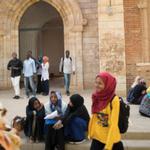
Part 1: Sudanese youth, politics, peacebuilding, and all the humanitarian "stuff"
From 2019 to Berlin
In the wake of the Third International Conference on Sudan in Berlin, convened to advance peace efforts, mobilize humanitarian assistance, and foster dialogue on Sudan's democratic transition, the Emergency Response Rooms in Khartoum issued a public statement firmly asserting that these structures are independent humanitarian initiatives formed in direct response to the eruption of war. On the surface, it reads as a procedural clarification: all participants are volunteers, no formal leadership structures, no founders or "co-founders,".
Yet the reaction to Berlin raises a question that goes beyond representation. It highlights the growing overlap between humanitarian and political action in a context where the movements that emerged after 2019 challenge conventional ideas of leadership and representation. It also points to the pressure on community-led initiatives rooted in Nafeer to adapt to the institutional language of organizations, mandates, and formal representation.
Berlin became one of those politically awkward moments that forces a rethinking of what "youth participation" in Sudan means and who gets to define it. In this blog, I want to revisit the narrative of unity that accompanied 2019 as a youth-led revolution, to understand how we moved from solidarity to today's landscape of deeply fragmented youth initiatives. I believe this deformation was bound up with a long-term strategy, to produce a depoliticized generation with a sustained historical amnesia.
Obedience, the safe civic virtue
One of the most striking features of contemporary Sudanese public discourse is how often political conversations begin with the disclaimer, "I'm not political or not affiliated with any party." Yet what follows is almost always politics—debating the future of the country, defending particular visions of the state, taking positions on war and peace, or deciding who should legitimately speak. Politics has not disappeared; rather, political identity itself has become something to disavow.
In its effort to consolidate power, the Salvation regime (El-Inqaz) gradually dismantled the spaces where political awareness was passed down from one generation to the next. Trade unions were systematically targeted and crushed. Student movements faced severe repression, and universities were closed for periods lasting an entire academic year as punishment for protests. Student leaders were tortured and assassinated under the banner of "fighting communism." These tactics were accompanied by changes to school curricula, tight control over the media, and the declaration of a holy war against the rebels in the south.
In its effort to consolidate power, the Salvation regime (El-Inqaz) gradually dismantled the spaces where political awareness was passed down from one generation to the next.
At the same time, the regime promoted an alternative model: the "good" young person was no longer the politically active individual, but the disciplined individual integrated into tribal (Native Administration) patronage, or Islamist networks—or the "service activist" who appeared only during floods and humanitarian crises to save the day. The regime succeeded in changing political disengagement from something driven by fear into a social and moral virtue. As political participation became dangerous, religious and moral discourse portrayed withdrawal from politics as a commendable and socially desirable way to behave.
Obedience became a civic virtue, while independent political organizations came to be viewed with suspicion. New student organizations emerged that explicitly defined themselves as "neutral," reflecting a suspicion of political affiliation rather than independence from it.
Opening the floodgate: Politics as a project
When the streets exploded in 2018–19, opening a floodgate for youth political participation, they brought together people shaped by very different political trajectories. Alongside those who had gained political experience through parties, trade unions, student movements, and years of organised resistance stood a generation whose public engagement increasingly had taken the form of volunteer work in community initiatives. During the uprising, however, these differences mattered little. As a result, the revolution was celebrated as a "youth-led" movement. While this accurately reflected the prominent role of young people, it oversimplified the political history of the movement, celebrating youthful courage while overlooking the decades of organizing that had laid the groundwork for collective action.
Once the regime had fallen, however, the question was no longer how to overthrow a dictator, but who could legitimately speak, negotiate, and organise in the name of the revolution. It was here that older suspicions of political parties, intensified by the Constitutional Declaration and the civilian-military partnership, converged with a much longer history of depoliticization.
Once the regime had fallen, however, the question was no longer how to overthrow a dictator, but who could legitimately speak, negotiate, and organise in the name of the revolution.
For decades, neoliberal reforms like privatization and a shrinking state have stripped public life of its political nature. This shift gave NGOs and funded civic groups more power, turning traditional politics into short-term, professionalized "projects." Instead of building long-term political organizations, people were encouraged to embrace "independent" and "non-ideological" activism. As a result, politics became something to distance oneself from, while simultaneously attempting to practice it through softer vocabularies: initiative, platform, civic engagement, dialogue, leadership, and all that stuff.
The issue is not NGOs or humanitarian work as such. Rather, the problem is the growing preference for forms of participation that are visible, institutionally recognized, and project-driven, at the expense of the slower and less visible work of building political organisation, accountability, and grassroots legitimacy.
This depoliticization had a major side effect on the newcomers, it didn’t just shift youth movements away from state-level structural reform, it fractured it from within. While the oppressive state structure remained unchanged, simply replacing Omar al-Bashir with Generals Burhan and Hemedti, the movement split over priorities and what was "practical." One faction retreated into localized survival, arguing that managing immediate day-to-day crises, mutual aid, and neighbourhood relief was the only realistic way to fix things What began as a radical, highly political push for democracy has frequently been stripped of its ideological teeth in the face of repression, suspicion, co-optation, institutional pushback, and now war.
This shift away from grassroots and collectively organized forms of participation can perhaps be seen most clearly in the rise of youth initiatives launched under the banner of "لا للحرب" ("No War"). Many of these groups now seek recognition through international conferences, policy forums, and donor-supported platforms. What makes this shift particularly striking is that many of their founders came from Resistance Committee Coordination structures but now operate through organisations focused on responding to immediate humanitarian crises. As these initiatives have gained some international visibility, publicly available information about their funding, governance, and decision-making has often remained limited, making it difficult to understand how well-founded their political legitimacy is, how representative they are, and who they are accountable to.
Searching for Coherence?
In this environment, international visibility became more valuable than local rootedness, and measurable outputs displaced political depth. Ultimately, youth ceased to appear as political subjects shaped by historical struggle. Instead, they were reduced to mere administrative categories - "victims," "beneficiaries," "youth leaders," or flexible instruments of change - entirely detached from the political histories that produced them.
The recent controversy surrounding Hajooj Kuka - publicly introduced by the UK Foreign Secretary as a founder of the Emergency Response Rooms - exposed a deep, systemic transformation. Political legitimacy increasingly derives from international recognition and funding rather than long-term grassroots organization. Yet, the platforms claiming to speak for Sudanese youth often erase this reality, removing the messy complexities and moral ambiguities from international conferences and policy discussions.
These unmentioned ambiguities are structural, not personal. They force horizontally organized, leaderless networks to accept top-down hierarchical recognition just to receive aid. They force radical, revolutionary youth to adopt a hollow language of "neutrality" to satisfy donor metrics, flipping their accountability away from local communities and toward foreign boards. Ultimately, it creates a dangerous divide between a small elite of platformed, visible "representatives" and the thousands of anonymous volunteers risking their lives on the ground without a voice.
Positioning is the path
The long history of "neutrality" traced throughout this blog, from the regime's dismantling of political infrastructure and the erosion of collective organisational memory to the restructuring of legitimacy along neoliberal lines has produced a landscape where visibility and recognition are more important than social roots and long-term political organizing. This is not an accident. It is the result of the long process that led to this war.
The challenge, therefore, is not to produce more initiatives or platforms. Instead, it is to strengthen the remaining spaces where collective political action still exists and to develop them into sustainable, socially embedded forms of organisation. This cannot happen without honest political positioning and a recognition of the knowledge and experience that have already been built through neighbourhood committees, Resistance Committee deliberations, and the ongoing effort to build genuine people's power.
Otherwise, politics risk being reduced to a simple economy: to be seen, to be invited, to be consulted, to be funded: all of that "stuff" that only reinforces the same hierarchies and the same patterns, only with more tragedies.
This Sudanese Perspectives blog post is written by Taharqa Elnour, a Sudanese researcher with interests in health economics, public health, and community engagement, particularly in resource-limited settings. He is also a photographer and visual storyteller whose work explores movement, labour, memory, and the social fabric of everyday life, including through his documentation of Sudan’s 2019 revolution and street protests.
The views expressed in this post are those of the author, and do not necessarily reflect the opinions of the SNAC project or CMI.