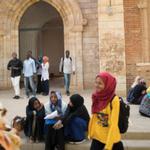
A nearly familiar place: Homecoming to the new old Khartoum
On the 10th of August, I woke up in my own house in Khartoum after sleeping away for almost three years. The morning light filtered through the windows with a quality I hadn’t realized I’d forgotten, yet the silence that accompanied it was different, perhaps, than the one I left behind in Cairo. To wake up here was to inhabit a paradox: I was finally home, yet I was a stranger to the new mechanics of my own life. My return was not merely a physical relocation; it was a jarring confrontation with a city that had been dismantled and reassembled in my absence.
Khartoum today is a "nearly familiar" place. It is a city that isn’t dead, but nor is it quite itself; it feels like a patient in the slow, fragile stages of recovery. While the streets remain etched in my memory, they have been scarred by conflict and re-mapped by necessity. The old life I naively assumed I could step back into has been replaced by a grueling process of relearning how to navigate a landscape stripped of basic services and pulse-pointed by army checkpoints.
However, this homecoming has been far from lonely. Through the daily stream of neighbors and friends who cross our threshold, it has become clear that while the urban geography has fragmented, the social fabric is being woven back together with fierce intentionality. In this blog I explore the complex, often unspoken "contract" between those who stayed and those who returned—a system where emotional labor, communal sacrifice, and the desperate hope for economic stimulus collide. In the absence of a functioning state Khartoum’s resilience lies in the people, the city’s social capital, which is now the engine of revival.
New geographies of the urban
The process of "relearning" Khartoum is a crash course in a new geography of urban fragmentation, dictated primarily by the degree to which different areas or neighborhoods were impacted by fighting both in terms of people being pushed to flee, and material destruction. While the portrayal of war in Khartoum, paired with a lack of on-the ground reporting had generated an imagary of a ghost-town Khartoum, demolished, the reality like in most war zones is that destruction is always partial, and concentrated. Omdurman city, for example, was less impacted by active fighting and resulting destruction, which meant that the population was less likely to leave. In parts of Omdurman therefore business has been continuing as usual almost throughout the war, and it is now a commercial hub due to the perceived safety and existence of material and economic infrastructures, including consistent, albeit rationed supply of electricity and water, as well as the partial operation of banks. Several enterprises have relocated there, including high-value commerce such as the gold stores, previously concentrated in the central Khartoum. Alaraby market's Amarat Aldahab for example largely relocated their operations to Alwady street in Omdurman.
A distinct model emerged in Bahry's northern sector: areas like Aldoroshab and Alsamrab also benefited from being spared from high-intensity combat, allowing for the relatively stable operation of services and daily life, even for the period when these areas were under the control of the Rapid Support Forces (RSF).
The central areas of the main city of Khartoum remain the most profoundly affected, having suffered the heaviest, most sustained fighting and subsequent mass exodus. However, the urban map is not static. As fighting has slowly died down in some areas, services and businesses are beginning to return. This gives hope to the people of Khartoum who see it as a sign of recovery.
For those who return, the central economic crisis is however that of the complete collapse of a wage-based job market. The resulting lack of employment forces an absolute reliance on remittances from the transnational community. This dependence on external transfers creates a dependency economy; and the incoming transfers are only sufficient for immediate, basic needs; due to the extortionately high prices for necessities like food and medicine. The hopes and expectations of the populations who remained in Khartoum throughout the war are however much more ambitious.
The re-weaving of the social fabric
The continuous stream of visitors since our return transforms the personal narrative of homecoming into a communal act of social continuity. The community is, in effect, re-establishing the social world that the conflict attempted to tear down.
An example of this emotional labor being performed in the community was one of many visits from extended family and neighbors: One morning, my mother received a visit from Aunty Huda and her daughters. Having walked through the low morning sunlight, to reach our home, they offered formal condolences for my aunt who had passed away while we were in Egypt, and brought a small container of food from Al-Takīya (the collective neighborhood kitchen). After the initial offering of grief and welcome, the conversation slowly turned to the market and survival. Aunty Huda tearfully mentioned that her son, who had lost his salaried job during the fighting, was now struggling to run a small trade business. She spoke about his struggle, how hardworking he was, and praised his goods, highlighting how he was providing better quality and a wider selection than others. She told my mother to go shop there, promising supreme service. She then gently changed the focus and asked my mother to reach out to me, as “The Returnee”, and ask me if I could perhaps provide some support – that meaning, funds to support the store and business. By asking, Aunty Huda was one of many examples of the unspoken expectations that those of us returning from Egypt had access to funds, and a deep hope that mine and others’ return might mean a much-needed economic stimulus. However – the truth is not that hopeful. Many of those who return from Egypt to Khartoum these days have done so due to the bleak prospects in Egypt, meaning that many families have exhausted their savings, and are returning to Khartoum seeking some kind of solace that was not found in Egypt. This exchange and the many, many like it show how while we return to a nearly familiar Khartoum, the social fabric has been and is still being re-woven. This seemingly simple exchange illuminates the immediate, practical welcome, where Stayers sacrifice their limited resources to uphold social custom, and the corresponding financial expectation placed upon the Returnees. Peeling back the layers of these new social constellations is going to be more demanding than many of us perhaps thought.
However, despite the painful inability to meet the hopes and expectations of beloved members of family and neighbors, we are still immensely happy and relieved to be back home. The sense of familiarity, care and tight relationships makes us, despite it all, feel much more at home than we were left feeling in Cairo and Egypt. The immediate welcome, exemplified by neighbors helping to clean our houses and providing us with initial necessities, shows that the bonds of kinship and neighborhood remain robustly in place, and unconditionally supportive. Yet, this entire interaction functions as a system of reciprocal social obligation. Those who had stayed behind offer the initial, vital support of presence, labor, and emotional affirmation. Simultaneously, the sheer volume of these customary visits places immense financial pressure on those who have returned, who are expected to uphold the social norms by providing hospitality. While willingly and lovingly given, hospitality entails providing snacks, tea, drinks, and many times an invitation to share a meal. The associated costs in today’s war economy are staggering, and my family is feeling the strain. This system creates an unspoken contract: the Stayers demonstrate their sacrificial commitment to the social fabric but hold expectations that Returnees with access to external remittances will fulfill their social obligations not only through direct hospitality, but by injecting capital and restoring local consumption. This complex exchange of those who stayed behind’s welcoming sacrifice, paired with the need for those who returned to provide customary hospitality; as well as these more unspoken, or quietly whispered expectations of economic stimulus highlights the enduring human imperative for connection, and the directly economic function it serves, to rebuild the local economy. The experience of coming back to the nearly familiar Khartoum is also a lesson in how the collapse of a national economy forces community bonds to carry the weight of both social and economic revival.
Social capital as the burdened engine of revival
For many in the transnational community, the emotional pull toward Khartoum is framed by a powerful, often simplistic nostalgia: a deep yearning for familiar streets, personal belongings, and the comforting predictability of an unbroken social life. Yet, the current reality of the city starkly separates this emotional yearning from the hard facts of revival, and the stark facts of war that is that the Old Khartoum is gone, and in its place is this nearly familiar space.
However, the city is undeniably returning to functionality. It is certainly better than the catastrophic ruin often portrayed by external media during the height of the conflict. This fragile, yet definitively tangible recovery is happening entirely from the bottom up. The ongoing task of revival is thus left not to the failed state apparatus, but to the intricate and sacrificial negotiations occurring daily between those who stayed and those who return. These complex social exchanges—where supportive welcome meets the unspoken expectation of financial contribution—are the true engine of recovery. Ultimately, Khartoum endures because its social capital remains robust enough to carry the immense economic weight of revival, proving that a city's deepest resilience lies not in its buildings, but in the unbreakable, though burdened, bonds of its people.
This Sudanese Perspectives blog post is written by Mohamed Jamal, Sudanese writer and researcher focused on the intersection of social, political, and economic studies. His work is dedicated to analyzing the structural shifts and societal changes Sudan and its people have experienced, beginning with the revolution and continuing through the current and after the period of war . He seeks to document and understand the deep impacts these historical transitions have had on Sudan's social fabric and political landscape.
The views expressed in this post are those of the author, and do not necessarily reflect the opinions of the SNAC project or CMI.