Theoretical doubts, or : Nepal’s knowledge spills on the Himalayan geology
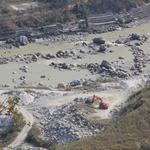
My dissertation is an ethnography of theories on Himalayan geology. It examines how a traffic of theories on Himalayas’ erodible geology came to be institutionalised, economised, and governed through twentieth century environmental history of Nepal. Shifting away from normative concepts of fixed geology, I focus on the materiality of fluvial geology: its riverine flows, its sedimentary erosion, and especially its historical classifications such as water-sand-silt. Across the four chapters, I show that from the mid-twentieth century to the twenty first century, Himalayan geology continued to evolve in meaning, moving from the universal theory of deep history of sediment erosion to a spatial concept of Nepal-India frontier border politics, through material and economic categories of spilling rivers-forests-soil-sand-silt, to the Nepalese sovereign pride in the uniquely steep and renewable energy generating mountainous geology that holds theoretical potential for water resources. These transforming geologic narrations on the Himalayas carry political, economic, and scientific visions for the seventy-two Nepali and international engineers, geologists, miners, activists, and hydrologists whose voices braid my dissertation. By tracing their eclectic circuits of knowledge production, I in fact chart the social production of doubt, especially its 1970s theoretical genesis in mountain-floodplain research on erosion, that translated the Himalayan geology into a problem of environmental instability, while also keeping intact the scalar uncertainties and ambiguities about fluvial sedimentary disasters for local extractive endeavour. I argue that in making the fluvial agencies of the Himalayan environment available for governance, the Nepalese state reinterpreted the current anthropogenic thesis that geological instability represents the ideological antithesis of social and economic change.