From war economy to peace economy: The role of youth in peacebuilding in Sudan
Sudan’s youth sparked a revolution but find themselves sidelined by a war economy that leaves them with few real choices. Their demands for political participation will materialise only when matched with economic conditions that make peace more valuable than war. When the youth get access to education, stable jobs, and partnerships with a private or public sector that depends on security to function, they can become the driving force that shifts Sudan away from an economy built on war to one built on peace.
Defining Sudan’s war economies
The main argument in this blog is based on Jonathan Goodhand’s framework that distinguishes between three overlapping dimensions of the war economy. The first is the combat economy, which includes activities that directly fund violence through control over resources, levies, and forced taxation, led by military actors seeking profit or authoritative (political) goals. The second is the shadow economy, which is the informal economy that emerges in weak states, managed by smuggling networks and organized crime, and often seized by belligerents to become a primary source of war funding. The third is the coping economy, which comprises survival activities resorted to by civilians, such as small-scale trade and remittances; these do not fuel the war out of greed, but out of necessity. This framework shows that failing to distinguish between "conflict beneficiaries" and "survivors" in the coping economy leads to harmful interventions that bolster the profits of the combatants.
The case of the Sudanese Armed Forces (SAF) clearly demonstrates these three dimensions. SAF relies on its control over state assets and a vast network of companies in strategic sectors within the combat economy, alongside control over the Port Sudan harbor and trade and relief flows. It relies on the shadow economy through the smuggling of gold and agricultural resources, benefiting from regional networks that grant some neighboring countries short-term interests in the continuation of the war. It also benefits from the coping economy by imposing informal fees on roads and checkpoints, and on the activities of civilians and humanitarian organizations.
As for the economy of the Rapid Support Forces (RSF), it is based on an informal economic empire whose backbone rests on organized looting and gold, which was and continues to be smuggled to the United Arab Emirates—the destination for most of Sudan’s gold—making the UAE a key actor (with short-term interests) in the continuation of the war. The shadow economy, consisting of "Shifshifa markets," forced taxes, and the smuggling of gum arabic and livestock, funds much of RSF’s operations. This overlaps with the coping economy through the imposition of fees on the movement of civilians and humanitarian aid, within a systematic strategy to destroy the formal economy and replace it with a violent economy based on plunder.
From a war economy to a peace economy
The peace economy refers to the collective economic activities that flourish in a stable and secure environment; it is the antithesis of the war economy, which is based on violence, plunder, and instability. In Sudan, the peace economy forms the foundation for any sustainable future, as it includes the sectors of agriculture, industry, and services—such as transport, telecommunications, and tourism—which are sectors that directly depend on stability. This economy is linked to the formal sector through state institutions, financial systems, and legislative frameworks that protect investments and ensure a safe environment for commercial exchange.
However, current political-economic analysis shows that actors in Sudan, and some regional countries, benefit from the continuation of the war in the short term, as the war economy constitutes a direct or indirect source of their political and economic gains. Consequently, stopping the war or building peace requires a strategic transition from a war economy to a peace economy through active interventions during the conflict that work to undermine activities fueling the war and support economic alternatives based on stability. Peacebuilding is a comprehensive process of re-engineering economic incentives, making war more costly than peace for the actors currently benefiting from it (the most powerful in the context), who view a just peace as a direct or indirect threat to their interests.
Based on this analysis, an actual transition to a peace economy requires rebuilding new socio-economic alliances in which the youth play a leading role, as they are an economic and political actor capable of contributing to the reshaping of the interests equation.
The role of youth in peacebuilding
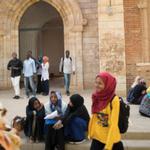
Sudan’s youth are the group most affected by the war economy and the least likely to benefit from its continuation. Systematically excluded from the wartime rents and pushed into violence and fighting, they do not possess large investments or cross-border rentier networks, which gives them a clear stake in stability and jobs. This interest qualifies them to be the leading force in the transition towards a peace economy.
Sudan’s youth are the group most affected by the war economy and the least likely to benefit from its continuation.
However, this transformation cannot be the responsibility of the youth alone; the transition from a war economy to a peace economy requires a strategic partnership with economic actors who have a direct interest in stability, foremost among them the productive private sector. This sector—unlike the parasitic capital associated with the war—is the most economically damaged by instability due to its reliance on regular supply chains, functioning infrastructure, and a stable workforce.
The importance of this partnership lies in building a new alliance of interests that links them around a common goal: making peace a necessary condition for profit and labor. The more the base of youth employed in formal productive sectors expands, the higher the political and economic cost of continuing the war becomes for armed actors and their associated interest networks.
Investment in vocational and technical training is one of the central keys to this transformation. The war economy does not require high skills as much as it relies on violence, whereas the peace economy requires a trained workforce capable of working in modern agriculture, industry, manufacturing, and services. Therefore, training programs should target youth directly, linking them to the actual labor market.
Vocational training serves as a dual-impact tool; on one hand, it creates a realistic economic alternative for youth away from the war economy, and on the other, it provides the private sector with a qualified local workforce that reduces its reliance on temporary labor or informal networks linked to the war economy. Thus, investing in youth becomes part of a rational economic strategy, not just a temporary humanitarian intervention.
Industry emerges as one of the most important drivers of the peace economy due to its heavy reliance on security stability, electricity, transport, and supply chains. Similarly, high-value-added agriculture represents a strategic sector; it transforms from a survival-linked activity into a lever for the peace economy when integrated into value chains that include manufacturing, storage, and export. This allows for the creation of extensive job opportunities for youth, both in primary production and in various associated activities.
The employment of youth in these sectors should be viewed as a politico-economic tool to re-engineer the relationship between war and peace. Every young person who obtains a stable income in a productive sector becomes less recruitable, more connected to stability, and more willing to defend the conditions of peace. As this base expands, peace gradually transforms into a broad social and economic interest, rather than just an agreement between elites. This path represents a structural condition for any sustainable peace in Sudan.
This Sudanese Perspectives blog post is written by Amro Awad Ali Osman. He is a development researcher focused on Sudan’s development challenges, with a particular interest in long-term institutional and social reform
The views expressed in this post are those of the author, and do not necessarily reflect the opinions of the SNAC project or CMI.
References
Goodhand, J. (2004). From war economy to peace economy? Reconstruction and state building in Afghanistan. LSE Research Online.
Osman, A. (2025). The transition from a war economy to a peace economy: The role of civil society organizations in peacebuilding Sudan. AMEL Institute; Sudan Democracy Action.
Craze, J., & Makawi, R. (2025). The Republic of Kadamol: A portrait of the Rapid Support Forces at war. Small Arms Survey.