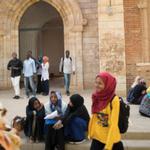
Part 2: Sudanese youth and the tug of war (شد الحبل)
The April War in Sudan shattered a generation once united in its opposition to militarization and its demand for democracy and civilian rule. Some have taken up arms, others have entered the war economy, many have left the country, while others have sought refuge in religious and moral discourse, searching for social justice.
Meanwhile, the charters that the Resistance Committees painstakingly developed remain unrealized, waiting to be turned into real political alliances and a future that genuinely belongs to Sudan's youth. Yet, little of this complexity is reflected in the international platforms claiming to represent them. The reality of these experiences, with all their contradictions and moral challenges, are erased in elite conferences, policy briefs, and donor presentations.
This was painfully illustrated at the April 2026 Berlin Conference, where high-minded declarations and over a billion dollars in humanitarian pledges were paraded. Four months later, almost nothing has been delivered on the ground, exposing these summits as exercises in performance rather than protection. Instead, mainstream discourse continues to portray Sudanese youth as a unified political category. This obscures their deeply fractured reality: while some act as vital agents of demilitarization, others are pulled in as vectors of militarization.
Four months later, almost nothing has been delivered on the ground, exposing these summits as exercises in performance rather than protection.
By flattening these differences, international actors gatekeep the transition. They decide who is deemed a "credible representative," shifting the focus away from political ideas and structural visions for change toward access to funding, platforms, legitimacy, and international networks. The first part of this series argued that this transformation has fundamentally reshaped how political legitimacy is produced in Sudan. This second part asks a different question: if age is not what makes youth a political alternative, then what does?
Pragmatic or intransigent?
This perspective is one of the central debates of the Sudanese repetitive uprisings — a tug of war that has pulled at all social movements from within every single time. Despite broad alignment between the Communist Party[1], leftist currents, many professional associations, and the Resistance Committees in rejecting both the military-civilian partnership and the Juba Peace Agreement in 2019, accusations of "party hijacking" began to surface. The charge that the revolutionary left was simply "intransigent" resonated strongly, including within parts of the Resistance Committees themselves, and calls to depoliticize the committees and shield them from partisan conflict became increasingly common.
However, concerns about reproducing partisan domination were entirely valid—particularly following the 2019 Constitutional Declaration signed between the Forces of Freedom and Change (FFC) and the Transitional Military Council (TMC). By establishing a civilian-military partnership to steer the transitional period, this agreement became a cautionary tale. It demonstrated exactly how organized political forces could negotiate away revolutionary demands behind closed doors, permanently deepening grassroots suspicion toward any structured party influence.
Yet, these legitimate anxieties quickly merged with an older political language shaped over decades. Suspicion toward ideology, formal organization, and collective political work was produced in two ways: first through authoritarian state propaganda, and later through neoliberal ideas. The latter favors flexible, technocratic forms of civic engagement over the slow and challenging work of building political organizations and institutions.
Why position, not age?
This systematic focus on fluid engagement over institutional organization exposes the core misdirection of contemporary discourse. The central question in Sudan has never been, and should never be, youth versus elders; political renewal is never guaranteed by generational change alone. Age is not the political alternative. Rather, the true alternative is structural positioning. Hassan al-Turabi and his brother-in-law Sadiq al-Mahdi both rose to national leadership at a young age, only to become pillars of the very establishment they once challenged. Age explained remarkably little. What mattered instead were the political structures they inherited, the institutions they occupied, and the ideological projects they came to represent.
The central question in Sudan has never been, and should never be, youth versus elders; political renewal is never guaranteed by generational change alone.
As Frantz Fanon warned in his analysis of postcolonial betrayal, postcolonial liberation projects are weakened not only by narrow elites but by the ways power reproduces itself through networks of patronage and inherited privilege. The problem is not the generation. It is the structure that imposes a brutal set of choices on those who seek change: to be captured by it without fully understanding its logic; to understand it and choose to use it for personal or factional gain; or to confront it directly and pay the price. In Sudan’s history, this has often meant marginalization, imprisonment, or death. These are not only moral choices. They are political and political-economy choices, shaped by the structure itself.
In Sudan, political exclusion is frequently misdiagnosed as a generational clash, a framing that depoliticizes the structural struggle over state power and institutional position. By reducing this conflict to a question of age, mainstream political discourse romanticizes youth as vital, revolutionary symbols while systematically disqualifying them from actual governance under the guise of cultural deference and lack of experience. This culturalist defense masks a deeper structural reality rooted in what Mahmood Mamdani terms the “bifurcated state.” Colonial indirect rule did not preserve organic traditional authority; it reconfigured and bureaucratized it into a rigid apparatus of top-down control. Successive postcolonial governments, particularly the Inqaz regime, integrated these colonial-era structures into systems of patronage and security-sector capitalism. Power in Sudan is therefore exercised through access to state-sanctioned positions. Youth are excluded from these positions, not because of their age, but because they are not part of the historical networks of patronage through which political influence is allocated
Same script, different cast
Sudan has rehearsed this cycle three times in living memory, demonstrating that position, not age, remains the enduring barrier to change. The first rehearsal came in 1964, when students and professionals overthrew Ibrahim Abboud, only to watch traditional sectarian parties hijack the transition. The script repeated in 1985, when a young generation ended Jaafar Nimeiry's rule, yet power was swiftly reabsorbed by elite networks—epitomized by a young but structurally traditional Sadiq al-Mahdi riding old waves of patronage.
Sudan has rehearsed this cycle three times in living memory, demonstrating that position, not age, remains the enduring barrier to change.
The final performance arrived in 2019. The Sudanese Professionals Association and Resistance Committees (RCs) provided the revolution's momentum and moral authority, yet the Forces for Freedom and Change (FFC) quickly sidelined them, treating the RCs as mere mobilizing infrastructure rather than sovereign political actors. In each instance, backroom negotiations took precedence over structural reform, culminating in the flawed 2019 Constitutional Declaration, the 2021 coup, and the devastating war of April 2023. These three uprisings, three intercepts, and three military reclamations prove that while the youth consistently do the dangerous work of dismantling a regime, entrenched political structures are always waiting to reclaim the state.
Why the Resistance Committees were different
What distinguished the Resistance Committees was not merely their energy or courage, but their capacity to learn from history. In a landscape designed to produce a depoliticized generation locked in sustained historical amnesia, the RCs chose to look back. They explicitly studied 1964 and 1985. Recognizing the old scripts, they refused to form a traditional party or appoint a single, easily co-opted leader. Following the 2021 coup, they issued their uncompromising "Three No's": no negotiation, no partnership, no legitimacy for the military. They understood that political renewal required more than removing figures at the top; it required dismantling the postcolonial structures that kept producing them.
This structural awareness is precisely what makes their subsequent fragmentation so politically costly. It was not the fracture of a movement that failed to understand its situation, but of one that understood it with unusual clarity—and was undone anyway. The RCs were not broken by military coups and party infiltration alone, but by the quiet mechanics of funding cycles, visibility politics, and the gradual replacement of political organizing with the "economy of recognition" traced in part one of this blog.
The old structures always find new entry points for co-optation. The enduring question—the one Sudan’s neglected grassroots charters are still waiting to answer—is whether this political clarity can be recovered and built upon before the next cycle completes itself. To scrub the political grime, we must first name it. Modern Sudanese history has given us more than enough warning to recognize clientelism and opportunistic favoritism, no matter how elegantly they are disguised as patriotism or pragmatism.
To be continued.
This Sudanese Perspectives blog post is written by Taharqa Elnour, a Sudanese researcher with interests in health economics, public health, and community engagement, particularly in resource-limited settings. He is also a photographer and visual storyteller whose work explores movement, labour, memory, and the social fabric of everyday life, including through his documentation of Sudan’s 2019 revolution and street protests.
The views expressed in this post are those of the author, and do not necessarily reflect the opinions of the SNAC project or CMI.
[1] Founded in 1946, the Sudanese Communist Party (SCP) was historically one of the region's most prominent leftist forces. Its legacy is deeply intertwined with the cultural aesthetic of Sudanese democracy and protest, popularized through the iconic poetry and music of Mahjoub Sharif, Mohamed Al-Hassan Hummaid, and Mohamed Wardi