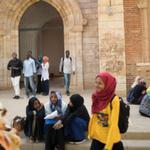
The unfinished politics of Sudanese youth
Sudanese youth never waited to be “included” in politics. They have repeatedly snatched the moment when opportunities for change arose, organizing, forming alliances, and pressing for their demands. Some clashed with young people defending regimes, standing behind riot shields and military barracks; others joined armed movements confronting the central government over the marginalization of the peripheries. Yet neither path secured a place for their demands in the negotiations that followed. Even when those who had shouldered the struggle articulated clear visions and developed charters of their own, they were left outside the rooms where the future was discussed.
In this blog, I look at the pockets of cohesion that have survived beyond the fragmentation of war, the co-optation of neutrality, and the depoliticization of survival. I ask what might prevent an emerging, quieter movement, whose experiences differ from those of previous generations, from articulating those experiences, making sense of them politically, and eventually generating demands for change that challenge the status quo.
A clash of resistances
Perhaps the problem lies in how political inclusion and peacebuilding are discussed. Such discussions often treat youth as a homogeneous bloc whose absence can be remedied by allocating them more seats in peace negotiations, transitional governing bodies, or other decision-making forums. A similar assumption underpins claims that different marginalized groups share an agenda, as though being marginalized were enough to bind them into a common project, regardless of differences in religion, ethnicity, class, region, and political position.
The “exclusion of youth” is often understood as a lack of representation in political decision-making. Participation then becomes the goal: activists are offered visibility, while spotlights and cameras create the appearance of inclusion. Yet the issue goes beyond who gets a seat at the table. Generational representation, important as it may be, cannot substitute for political representation grounded in a programme that addresses the roots of the problem.
One young person may be active in a Resistance Committee in Khartoum, another in a Darfur network, another in an armed movement, and another in humanitarian work, smuggling, or gold mining. Some have joined the war; others grew up in exile or left. They may share a generation and a stake in Sudan’s future yet inhabit different political worlds and hold diverging views of the state, its violence, and peace.
This fragmentation does not mean young Sudanese lack political consciousness. But historical amnesia and the absence of a unifying programme make them more vulnerable to competing with power projects. Where shared memories and political direction are absent, armed actors, parties, donors, and former-regime networks can more easily instrumentalize youth. The danger is that division becomes an entry point for co-optation.
Competing economies of legitimacy
Explaining these shifts, from pro-civilian coalitions to anti-civilian or pro-SAF positions, through naivety, limited political experience, Islamist ‘brainwashing,’ or wartime propaganda alone, overlooks the political frustrations that preceded the war. It reduces young people from political actors capable of changing their positions to victims of manipulation. Many who protested against Bashir’s regime and its economic policies had become disillusioned with the transition, particularly over the partnership between the Forces of Freedom and Change (FFC) and the Transitional Military Council, the 25 October 2021 coup by Burhan and Hemedti, and subsequent deliberations over the Political Framework Agreement (PFA). Meanwhile, the RCs articulated their own political visions through their charters after the coup. The struggle was therefore over who could claim political legitimacy, whose demands would shape the transition, and which political visions would be taken seriously.
This distinction matters especially after the outbreak of April war. Sudanese youth can no longer be understood as bearers of a single political position emerging from the December Revolution. The war has reshaped their alignments according to location, interest, and experience. Yet, despite their diverging positions, they remain bound by a shared fate—and are increasingly compelled to compete within fragmented spaces.
One such space is the war economy, sustained not only by the material networks and interests that keep the war going, but also by claims to sovereignty and the defence of Sudan against foreign intervention, which lend legitimacy to military mobilisation. For some, joining the army is framed as a response to violations committed by the Rapid Support Forces (RSF)[1]. For others, alignment may be shaped by the pressures of survival and the need to protect themselves or their communities.
The other is an economy of recognition, built around civilian legitimacy and international engagement. Taqaddum emerged as one political expression of this current, bringing together FFC elements that supported the PFA. It later split into two prominent alliances: Somoud and Tasis. Somoud brings together several FFC parties and diaspora civil society organizations under the banner of ‘No to War.’ Tasis aligned itself with the RSF and announced a government in areas under its control. Both alliances include young people. Their participation should not automatically be dismissed as insincere or as evidence that they simply act under others’ direction. The key question is whether they can influence the agenda, challenge decisions, or organize independently.
Pockets of cohesion amid fragmentation
A third current, harder to trace and far from politically unified, consists of pockets of older Resistance Committee networks and Emergency Response Rooms (ERRs). Unlike those drawn into military mobilisation or political alliances seeking civilian and international recognition, these networks have sustained local organising and adapted to wartime conditions in their neighbourhoods, often without centralised leadership.
Their reluctance to seek visibility does not necessarily signal withdrawal or passivity; it may help preserve their political autonomy. Yet this autonomy has a cost: the same distance from established political structures that protects their independence also limits their ability, for now, to shape the arrangements that will determine how the war ends and what follows.
Youth inclusion is therefore more than a peace-building slogan. What matters is not whether young people are brought into the room, but whether they can influence what happens inside it. Otherwise, inclusion becomes symbolic: the messenger is welcomed, but the message is left behind.
For chanting in the streets only

Young people played important roles in Sudan’s popular uprisings of 1964, 1985, and 2018–19, helping to bring down successive authoritarian regimes. During the 2018–19 revolution, the (RCs) developed charters articulating their own political visions. Rejecting the old politics of personality, they sought to build a movement driven by a collective vision. They repeatedly invited political forces and civil society organisations to develop the charters with them and rally around them. Yet their invitations fell on deaf ears in the corridors of power.
A telling example is the disagreement between Volker Perthes, the former head of UNITAMS, and Khartoum’s (RCs) over negotiations following the 2021 coup. International responses often framed the crisis through urgency and the risk of further instability. On 10 March 2022, Perthes warned that Sudanese do not have unlimited time and that there is a risk the country will slide into further instability. The (RCs), however, rejected negotiations with the coup leaders, arguing that such negotiations would legitimise the existing authorities. The disagreement was not about the urgency of restoring a political process, but about whether negotiations involving the military could provide a credible path towards civilian rule.
Conclusion
Sudanese youth may appear as a “beneficiary” of a peacebuilding project, a “youth representative” at a conference, or a “civilian face” in a political process, yet lack the power to influence the decisions that are made. Even when young people propose that genuine stability cannot be achieved through another power-sharing arrangement among established political forces, they are kept out of the discussions where power is renegotiated. And so, the cycle repeats: a new generation becomes entangled in struggles over representation and legitimacy while the consequences of war continue to pile up.
The challenge is not simply to reclaim a place at the negotiating table, but to turn a long history of dispersed experiences of resistance—to injustice, atrocities, and the maldistribution of wealth and power—into a political force capable of challenging the arrangements that made the war possible and continue to shape its course. Rejecting war is necessary; building an organised movement capable of confronting the political and economic conditions that sustain it is a different task. Whether the older (RCs) networks and (ERRs) that have sustained local organising amid war can engage with their peers and contribute to such a movement remains an open question.
This blog post concludes a three-part series on Sudanese youth and political change. Part one of this series, “Sudanese youth, politics, peacebuilding, and all the humanitarian ‘stuff’”, explored how depoliticization was engineered and rewarded through an economy of recognition, while part two, “Sudanese youth and the tug of war (شد الحبل)”, challenged the narrative that unwanted outcomes were due to generational conflict alone and asked why each “new” generation repeatedly falls into the same trap.
This Sudanese Perspectives blog post is written by Taharqa Elnour, a Sudanese researcher with interests in health economics, public health, and community engagement, particularly in resource-limited settings. He is also a photographer and visual storyteller whose work explores movement, labour, memory, and the social fabric of everyday life, including through his documentation of Sudan’s 2019 revolution and street protests.
The views expressed in this post are those of the author, and do not necessarily reflect the opinions of the SNAC project or CMI.
[1] Ghayaz Alagha’s “Seed Alwjaha” ft. Raghad is a Sudanese patriotic rap anthem honoring the jayashi — the Sudanese soldier — and celebrating the army’s role in defending the homeland
https://www.youtube.com/watch?v=DwKX97voKAk